
Awareness of license inefficiencies is a critical first step, but it is not enough. In today’s enforcement-driven environment, organizations running Dynamics 365 Finance &
Operations (F&O) must move beyond identifying risks to systematically addressing them. This requires a structured & repeatable approach that transforms license optimization from a reactive activity into a governed, ongoing capability.
Why a Framework Matters
Many enterprises recognize issues such as over-licensing, role misalignment, and limited usage visibility. However, without a defined framework, optimization efforts often remain:
- One-time exercises triggered by audits
- Dependent on manual analysis
- Disconnected from business and financial planning
A formal framework ensures that optimization is consistent, measurable, and aligned with organizational goals.
A Practical License Optimization Framework
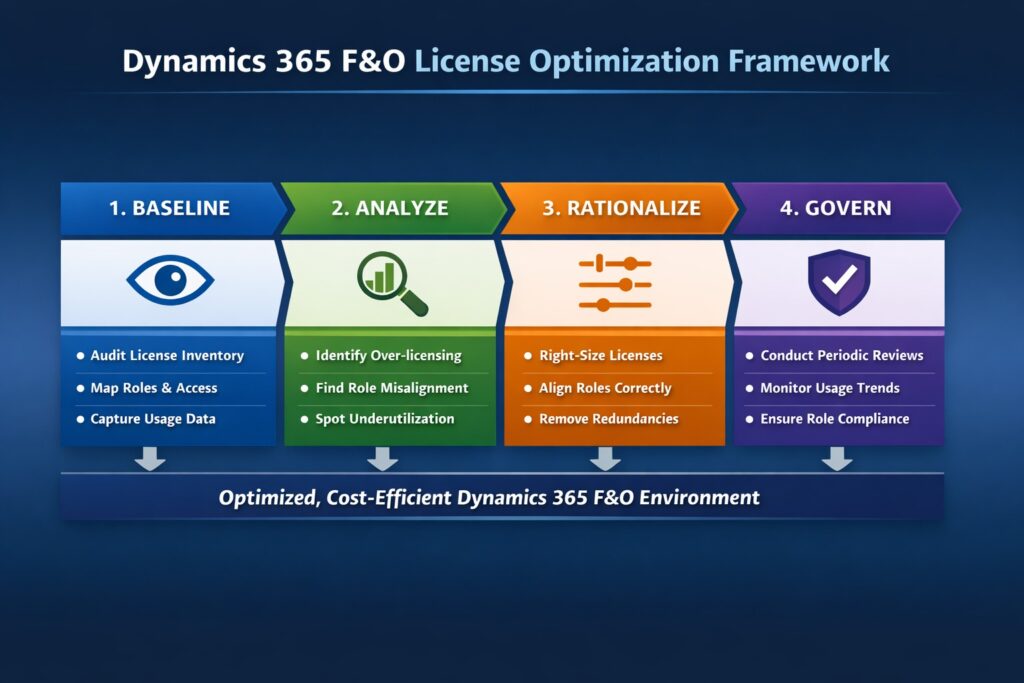
A robust approach to Dynamics 365 F&O license optimization can be structured across four key stages:
1- Baseline: Establish Visibility
The first step is to build a clear view of your current license landscape.
This includes:
This includes:
- Mapping all users to assigned licenses
- Understanding role definitions and access levels
- Capturing current license consumption and allocation
The objective is simple: create a single source of truth.
Without visibility, optimization decisions are based on assumptions rather than data.
2- Analyze: Identify Gaps and Inefficiencies
Once visibility is established, the next step is to uncover misalignment.
Key focus areas include:
- Users with higher-level licenses than required
- Underutilized or inactive licenses
- Roles that do not reflect actual job responsibilities
- Temporary or project-based access that remains active
This phase often reveals hidden inefficiencies that are not visible in standard reports.
3- Rationalize: Align Licenses to Actual Needs
With insights in place, organizations can begin rationalization.
This involves:
- Reassigning licenses based on actual usage patterns
- Aligning roles with appropriate license tiers
- Removing redundant or duplicate entitlements
- Cleaning up inactive or unnecessary access
The goal is not to reduce licenses arbitrarily, but to ensure each license delivers measurable value.
4- Govern: Make Optimization Continuous
The most critical and often overlooked stage is “governance”.
To sustain optimization, organizations should establish:
- Periodic license reviews (quarterly or bi-annual)
- Role-based access validation processes
- Monitoring mechanisms for usage trends
- Alignment between IT, finance, and business stakeholders
This ensures that optimization is not lost over time and evolves with organizational changes.
Key Success Factors
Organizations that successfully operationalize this framework typically focus on:
- Cross-functional collaboration: Aligning IT, finance, and business teams
- Data-driven decision-making: Moving away from assumptions
- Process integration: Embedding optimization into regular operations
- Proactive planning: Addressing inefficiencies before renewal cycles
These factors help shift license management from a cost center activity to a strategic function.
From Reactive Fixes to Strategic Control
In many organizations, license optimization begins as a response to audit pressure or rising costs. However, the real value is realized when it becomes a continuous governance discipline. By adopting a structured framework, enterprises can:
- Improve cost efficiency
- Strengthen compliance readiness
- Enhance operational transparency
- Make more informed renewal decisions
Closing Perspective
Insight without action creates awareness but not impact.
As license enforcement models evolve, organizations must take the next step: building a framework that translates insight into sustained value.
Because in the long run, it’s not just about understanding your license landscape – it’s about controlling it with precision and confidence.